I have a good friend that is embroiled in sleep-training her little one. We had our fair share of sleep-training with both Henry and Silas (who were difficult in different ways) and I've managed to become somewhat of an expert on some different techniques for the grueling process. Lots of people don't agree with any version of sleep training but we do. JT and I believe that you're teaching a child how to sleep well for the rest of their lives. Tammy posted some sleep training questions and i thought i would use this post to provide my answers to them. For the record there are two sleep books i would absolutely read: The first is Weissbluth's Healthy Sleep Habits Happy Child and if you happen to have a non-colicky baby the book 12 Hours Sleep in 12 Weeks.
1. Do we set up our pre-training “bedtime” environment? Do we turn on white noise, let her turn on her crib aquarium, leave music playing, dim lights? Or is now the time to simplify our sleep “crutches”? (we left our set-up the same)
You need a routine for bedtime. It can be very simple. If you already have one continue to do it. If you want to inject one additional thing (i think the white noise would be great especially given question 7) but i wouldn't add any additional steps before you actually put her down to sleep.
2. What if she poops/pees?
I thought she had pooped one night so I changed her. It turned out to just be pee, but it probably was good to wake her up a smidge after the feeding anyway.
If she poops you need to change her. No worries if it's just a wet diaper. It's nice not to have to change her but if you do you do and it's not a deal breaker. Unless you have reason to suspect she's got a dirty diaper after you feed her, i would change her before you feed her so that she's already drowsy and ready to go back to sleep after you feed her.
3. What about naps? Do we do sleep training for her daytime naps? We can NEVER get her to take naps. Still completely unresolved.
If she's having a hard time with naps you will most likely want to sleep train her with naps as well. Speaking from personal experience, i would wait to work on naps until you've got the nighttime ironed out pretty well. Weissbluth offers sleep research to indicate that daytime and nighttime sleep are neurologically different. Therefore using sleep training techniques at night and not during the day isn't actually confusing. Based on some of the same research though, daytime sleep is more difficult to "train." Ideally you will be healthy and have some good nighttime sleep under your belt before you attempt nap training. You must read the Weissbluth book before you get started because you will have many questions about how to do this.
4. Does the method recommend that you go completely cold turkey with no feeding at night? Or do you ease into sleeping through the night?
I've actually not read Ferber's book so i can't attest to his method. Depending on the age of the child and if there are any weight gain issues i think it's a choice about what strategy works best regarding night-time feedings. My personal preference and what i think is easiest to implement is to follow the steps that are outlined in the 12 weeks book and that i shorthanded below to lengthen the times between nighttime feedings and then work on phasing them out all together.
5. How to extend the period of time between feedings? What if she falls sleep during these nighttime feedings?
The 12 hours sleep in 12 weeks book offers step by step guidance for how to lengthen the time between nighttime feedings and eventually work on phasing them out all together. First she tells you to keep a log for a few days of at what times she's eating now and for how long. Then you work on a two-pronged strategy to lengthen the time between the feedings and shorten the feedings until you've eliminated each one.
From your post i think she's eating twice a night roughly around 1 am and 4 am. You set those as your new goalposts and you never feed her earlier than that. If she wakes up earlier you use your toolbox (could be letting her cry, giving her a pacifier, patting her, etc.-- see the book for a complete discussion of different techniques), to get her to the goalposts you set. The idea is to always move the ball forward and not let them creep backwards. If she wakes up and eats at 1:30 am tomorrow that becomes your new goalpost. Basically the idea is if she did it once she can do it again.
You also note how long she's eating. If she eats for 15 minutes at each feeding you start there. Every few days you reduce the amount of time by 2-3 minutes. If at any point she eats for less than that (and doesn't wake up with some gentle prodding) that's your new "time limit." There's something i'm forgetting about the order with which you phase out the feedings. So you're just going to have to read the book!
6. Is it ok if they fall asleep while you’re nursing them, then you wake them back up when they’re in the crib?
Weissbluth argues that it's fine if they fall asleep while they're nursing. It's a normal response to a totally soothing and relaxing ritual. You don't have to undergo any shock treatments to fully wake them up while putting them in the crib. Just lay them down normally so if they wake up they wake up but you're not setting out to arouse them from their peaceful slumber.
7. Should we be “extra quiet” in the rest of the house? We live in a small 1 bedroom floor-thru apartment, and I know Sadie sleeps at daycare when there are toddlers screaming about. So, should we get her to sleep with our standard-noise-level, or do we just need to learn to turn our standard-noise-level down? (we put headphones on to watch tv and tip-toed around the house)
No, you shouldn't be extra quiet. I would recommend the white noise machine (or waves or any other kind of soothing sound machine) to give her some buffer but she needs to be used to sleeping with normal night noises. This will help in the long-run if you ever want her to be able to sleep if it's not perfectly quiet. This won't help if you want to have friends over, and it also won't help if she's at camp sharing bunkbeds and the crickets are too loud.
Finally-- in addition to telling you that you really need to read the books, i'm also going to suggest that you try moving Sadie's bedtime up by 15 minutes and see what happens. Especially if she's struggling with naps i have a feeling she's overtired which makes getting them to sleep that much harder. Reach Weissbluth and we'll talk some more.
Finally, finally from one parent that has gone through this to another: this is hard. It's hard because it's terrible to hear your baby cry, it's terrible to know that the situation before wasn't good and there's no going back, but to not be able to see clear to the other side. It's terrible because as you noted, all the crying and the not knowing and the wondering and the questions sets you on edge, and your partner on edge. Call for support when you need it, read some books so that you've got an expert weighing in with the advantages of a good sleeper, and take breaks from the sleep training. You can take turns walking around the block or running to the drugstore just to get some distance from the crying.

Showing posts with label sleeptraining. Show all posts
Showing posts with label sleeptraining. Show all posts
12.16.2008


1.10.2008
Silas Sleep Bulletin

I've spared you some of the gory details, but after being on a wild sleep roller coaster with Silas over the past 6 months, we finally knuckled down and "sleep trained" little Silas. If you've been glancing at "Silas Wake-Ups" box you might have noticed a recent string of un-interrupted nights of sleep. After we got past possibly the very worst night of my life, Silas has just slept well.
His night wakings were increasing in frequency and duration and he was proving averse to going back to sleep. It was like dealing with a drug-resistant strain of baby sleep virus. We knew that after the New Year we were going to work on sleep training but had purposefully put it off until we were back home from our New Year's trip to Michigan. While in Michigan we were all sleeping in one room and we were away from home which were not ideal conditions under which to begin the process.
Unfortunately it was also really hard for anyone to get to sleep if Silas was getting up 4-5 times a night and not going back to sleep. So, start the training we did. The first night wasn't too bad-- i think he cried off and on for about 45 minutes and then slept through the rest of the night. The second night however, was potentially the worst night truly of my life.* He cried off and on for 3 hours (until 2 in the morning) at which point i finally picked him up and held him and got him to calm down enough to go to sleep.
Henry's worst night clocked in at 1 hour 40 minutes, but he was all scream from the first second you laid him down. Silas is more fuss, whine, cry a little, quiet down and just sound mad (ba, ba, ba, ba) then start fussing and crying so more, a little screaming, quiet down, repeat. It's like because he's more mild-mannered he has more energy to extend his stubbornness. So, i figured that this sleep training was actually going to be worse with Silas than it was with Henry.
But thankfully we made it through the horrible night and since then it's been almost all smooth sailing. Last weekend he woke up both nights for about 10-20 minutes and then went back to sleep on his own. All this sleeping has us thinking that before too much longer Silas will be moving downstairs into the room with Henry. The only thing holding me back is that Silas still nurses in the morning and it's a lot easier to take care of that upstairs than downstairs will Henry will then be guaranteed to wake up shouting "i want to help you make coffee!"
*i'm thinking the only other contender would be the time JT and i got lost in the woods at night trying to re-find our tent (without a source of light). After JT almost stumbled off a cliff we decided to lay down and sleep right there on the ground. It was fall in the Shenandoah so we had on light cotton sweaters and shorts, which even with the newspapers we were using as a blanket, was still the coldest, most horrible night i've ever had. I guess at least with sleep training i was warm.
10.12.2007
Silas sleep machinations
You guys haven't had a sleep update in awhile and although it isn't necessarily the most riveting topic for my general readers, it's really helpful for me to document where we are on the sleep continuum at any given age.
Because of Silas' growth concerns, i was told to continue the "dream feed" that i was doing around 10 pm each night. The way this is supposed to work, involves picking the baby up and feeding them while they are awake enough to eat, but don't fully awaken. For several weeks this worked like a charm. Around the time the Dr. told me i needed to keep doing it, Silas started waking up on his own and not being comforted by just a pacifier. I would have to feed him to get him back to sleep. He's started doing this earlier and earlier to the point that we've gone from a 10 pm dream feed to one around 8:45.
I'm not entirely sure if i should just keep feeding him at whatever time he wakes up or if at some point soon i should let him break the habit and re-set the feeding clock closer to 10.
Also, Silas alternates nights where he sleeps either all night or with only one brief wake-up with nights like last night where he was awake 2-3 times and then around 5 wouldn't go back to sleep until he was fed. I get the sense on those nights that he's hungry and stymied from going back to sleep for good because of the rumblings in his tummy. I've periodically offered him an extra bottle of milk before bed, but maybe i need to make that part of our standard practice now.
Other than sleep details, we've given the boys baths together twice in the past week. Silas still goes to bed really early so Henry winds up having a bath before dinner. It's not completely ideal because he can still get fairly messy at dinner, but that way they both get a bath and Henry is more likely to get into bed closer to 7:30 than 8:00 which is often too late for him. Lest you think Henry is already bored with his little brother-- i thought i'd post two pictures so you can see they're BOTH having a good time-- just not in the same photo.


Because of Silas' growth concerns, i was told to continue the "dream feed" that i was doing around 10 pm each night. The way this is supposed to work, involves picking the baby up and feeding them while they are awake enough to eat, but don't fully awaken. For several weeks this worked like a charm. Around the time the Dr. told me i needed to keep doing it, Silas started waking up on his own and not being comforted by just a pacifier. I would have to feed him to get him back to sleep. He's started doing this earlier and earlier to the point that we've gone from a 10 pm dream feed to one around 8:45.
I'm not entirely sure if i should just keep feeding him at whatever time he wakes up or if at some point soon i should let him break the habit and re-set the feeding clock closer to 10.
Also, Silas alternates nights where he sleeps either all night or with only one brief wake-up with nights like last night where he was awake 2-3 times and then around 5 wouldn't go back to sleep until he was fed. I get the sense on those nights that he's hungry and stymied from going back to sleep for good because of the rumblings in his tummy. I've periodically offered him an extra bottle of milk before bed, but maybe i need to make that part of our standard practice now.
Other than sleep details, we've given the boys baths together twice in the past week. Silas still goes to bed really early so Henry winds up having a bath before dinner. It's not completely ideal because he can still get fairly messy at dinner, but that way they both get a bath and Henry is more likely to get into bed closer to 7:30 than 8:00 which is often too late for him. Lest you think Henry is already bored with his little brother-- i thought i'd post two pictures so you can see they're BOTH having a good time-- just not in the same photo.


7.31.2007
4 Months, 4 Days/ 2 Years, 3 Months, 1 Week

I know i've been remiss in posting lately. I have a few ideas for things i'd like to write that will require me to sit-down and focus, and i haven't been able to come up with that time lately. Work has certainly picked up and we've been pretty busy on the personal front as well.
Because Chicago has a much longer winter than summer i feel like each weekend, nay each day, needs to have enjoyable summer activities planned into it. Of course we have to schedule laundry and grocery shopping in there somewhere, but we've been doing a pretty good job of accomplishing fun stuff. Friday we finally made it to the pool by our house and Henry got excited all over again about swimming. I've taken to heading there after i pick the boys up from Brenda's, because the baby pool area is completely shaded and it's not as busy as on the weekends. We only wind up with about 30 minutes before the pool closes but that's a decent-enough amount of time-- especially considering Silas would really prefer to start getting ready for bed around 6-- more on Silas and sleep later.
This weekend we enjoyed a really nice bbq at Tiffany and Mike's house and Henry FINALLY got to see "Mike's Dogs" as he calls Zippy and Josie. Even better, he got to play "Hide Seek" with Helen and Carys. A high point of the night for us was that Henry went to bed uncomplainingly on a pallet on their floor, and Silas slept in the pack-n-play without much fuss. Unfortunately neither of our kids have ever let us fulfill the "transferring a sleeping child to the car" scenario that i see in my minds-eye movie of parenting. Our children wake-up and stay awake-- looking dazed, all the way home. Henry always goes right back to sleep once he's in his own bed, but this move threw Silas off his game. And here's where i start to become consumed by sleep issues again...
On Saturday Silas took a 5 (!) hour nap and went to bed like normal right about 6:30. We woke him around 11 to head home and he didn't sleep great that night (which didn't surprise me). The next day however, he wouldn't nap for more than 30-45 minutes at a stint and would wake up absolutely crying. He couldn't be soothed back to sleep and in general seemed overtired and miserable. That night i worked and worked to get him to go to sleep for the night and he put up a fight to say the least. We decided that it was time to commit to sleep training the little guy. We went through this with Henry around this time and it was truly terrible.
I was feeling like it was almost worse with Silas because he was surprisingly stubborn when it came to sleep training. Silas has been and continues to be a happy mellow baby. Everything i've read about babies with mild temperaments indicates that you might have around 20 minutes of crying and you've got the whole thing whipped in 3 days. The first night Silas cried off and on for 2 hours. Most of the time it wasn't full-on screaming, but he was definitely crying and NOT sleeping. Last night was better-- i think he only cried 20 minutes when we put him down, but he cried quite a few times during the middle of the night. He hasn't eaten in the middle of the night for almost a month but he's very resistant to falling back asleep on his own.
I was feeling drained and vulnerable the way only an infant's incessant crying can make you feel so i re-read some of my sleep books-- in particular Weissbluth's Healthy Sleep Habits, Happy Child. He helped me remember why we were "sleep training" in the first place and realize that this is short-term pain for long-term progress. After my experiences with Henry i do truly believe that good sleep habits are a crucial skill for babies to learn.
The only thing that caught me off guard, is that we're having to "teach" Silas these habits. I thought we might have lucked into one of those babies that somehow figure this out on their own. That's why the first night of crying was so difficult and unexpected. I'm hoping that with some good naps under our belt, and reduced crying at bedtime (and did i mention that 6 pm bedtime routine) we'll be on our way to solid-sleep habits for all of us. I'll let you know.
3.03.2007
Roundtable- Sleeping
This week we’re set to talk about sleeping which is a topic I definitely have first-hand experience with, because it is something we really, really struggled with when Henry arrived. I’m not entirely sure how to structure this week so I’m going to start tonight with the things that I wish I had known about sleeping BEFORE Henry arrived. Let me know if there are questions you have or ideas for sleep sub-topics and I’ll address those as the week progresses!
In the beginning…
For the first few days and sometimes up to 2-3 weeks, many babies will seem to literally sleep all day. They’ll wake to eat and maybe open their eyes a few minutes and then it’s back to sleep. I remember the day we got home from the hospital Henry slept for 6 hours straight which turned out to be his longest stretch of sleep until about 3-4 months! Of course we didn’t enjoy it because after 3-4 hours we kept trying to wake him up every 30 minutes to get him to eat. You’ll hear differing advice on this but unless your baby had a low birth weight or s/he’s routinely sleeping through feedings—I say just let them sleep and don’t worry about trying to wake them to eat.
In these first days, your baby may seem to sleep all day and then be awake much longer chunks of the night. I believe I remember reading that babies don’t manufacture melatonin which helps us regulate day from night until later so there’s no physiological reason to sleep at night at the beginning. This is why you’re encouraged to keep everything quiet and boring at night so there’s no social reason for them to be awake at night and asleep during the day.
Learning to Sleep
Somewhere along the first few days to weeks, your baby may “forget” how to sleep. I’m sure that not all babies are like this but I’ve heard and read lots of accounts of babies that were total sleepy-heads until 2-3 weeks and then suddenly seemed to stop sleeping altogether. This is definitely something that we went through with Henry. A BIG part of the problem was that I didn’t realize that some babies need help to get into a sleep rhythm. I was under the impression that if a baby was sleepy s/he would fall asleep. Unfortunately it isn’t this simple for all babies. Some babies aren’t very good at drifting off to sleep on their own and as they start to give us cues that they’re now over-tired and cranky, we respond by going through the checklist of things that might help—change the diaper, change of scenery, playtime, etc. If the baby is really tired everything we try just makes it worse.
The trick is in realizing that your baby is starting to get tired so you can help soothe them and let them fall asleep on their own. Ideally you do this from the start and then they “learn” how to fall asleep on their own without any complicated interventions that get tried later on. The sleep cues babies give can include:
· Decreased activity
· Slower motions
· Less vocal
· Sucking is weaker or slower
· Quieter
· Calmer
· Appears disinterested in surroundings
· Eyes are less focused
· Eyelids are drooping
· Yawning
Signs such as fussing, rubbing eyes, and being irritable and cranky are actually signs that your baby is overtired. The best thing to try at the beginning is to recognize the signs of sleepiness. If you catch them you’ll want to put your baby in her crib or wherever s/he sleeps. She might fuss a minute or two and then fall asleep. Or, your baby might need to be actively soothed in which case you might try a pacifier, swaddling, rocking, shushing, etc.
The other important thing to know is that for the first few months, babies need to sleep after being awake for 1-2 hours. While getting them on a nap schedule at this point isn’t really workable, it does help to know that your baby woke up at 9 am and therefore most definitely needs to be back asleep by 11, and you might start seeing signs around 10 that s/he’s ready for sleep. Keep that 2-hour wakefulness period in mind and it will really help when you’re still trying to learn your baby’s sleep cues.
Sleep Duration
As babies get older it’s more important for them to sleep for longer periods of time and most of them will achieve this on their own. I think that if you’re tuned into a baby’s sleep needs—i.e. watching for sleep cues and helping soothe them to sleep no more than 2 hours after they last woke, you’ll find your baby sleeps longer at a time anyway. But, you should know that not all babies sleep for even a magical 3-4 hour period at first. It can literally be the case that your baby gets enough sleep overall—but gets that sleep in 20-30 minute increments. This is why it’s really important to give some thought to how you’re going to get some rest once the baby arrives.
Back-up
I’m not sure you can prepare a “plan” before your baby arrives, because you just don’t know what sleep challenges you’re going to face (maybe none!). I do think however, that you can brainstorm some possible ideas to put into place once you know what issues you’re dealing with. For example, because I was breastfeeding exclusively, I needed to be available (and awake) for all the feedings. I would feed Henry around 9 pm and then go straight to sleep while JT stayed up with Henry or Henry slept with JT on the couch. Then JT would change Henry and bring him to me for the midnight feeding. I wasn’t getting 8 hours of un-interrupted sleep, but I was getting a head-start on my sleep for the night. Also, before I went back to work, Henry would usually wake around 5 or 6 am for a feeding. At that point I would bring him into bed with me and after eating we’d both fall back asleep until 8:30 or 9. I made sure to never schedule anything before 9:30/10 and that also helped me get some extra sleep.
Other things to consider are having a post-partum doula or babysitter come over an afternoon or two a week (or family member) to watch the baby while you take a nap. A lot of women that co-sleep say that they completely avoided the sleep deprivation of a newborn, because when you’re nursing in bed you’re able to basically start nursing and then just fall back to sleep (assuming you’re nursing lying down). Other people may have lots of other ideas, but here are a few to get you thinking about how you’ll deal with the sleep deprivation.
I also want to emphasize that I say this not because you’re being “hazed” into a new parents club, but because having a newborn can be exhausting and if you don’t make efforts to get the rest you need you’re at risk for getting sick, overwhelmed, depressed or all of the above.
Q&A
Q: For everyone with babies, when did they start to have a "normal" sleep schedule? Was there anything that you did in particular that helped them fall asleep or sleep through the night? At what point did you see if the baby can soothe his/herself and stopped going into the baby's room every time the baby woke up?
A: I have to say that even though I kept meticulous records I don’t remember very clearly what Henry’s sleep schedule was really like. What I did do was go back to the sleep book that really helped us called “Health Sleep Habits, Happy Child.” Sleep is a hot topic with parents-- not only because new parents are so sleep deprived but because how we treat our children's sleep has become a marker of the type of parent we want to be perceived as. There are "attachment parents" who would never dream of letting their children cry themselves to sleep and "cry it out" parents who wouldn't want their children's sleep to be dependent on them for very long. This book, HSHHC is perceived by some people as firmly advocating a “cry it out” strategy and is therefore dismissed by people that disagree with the practice. I do want to say that the book is written by a Doctor/Sleep Researcher and it definitely has a “scientific/researchy” bent to it. He provides suggestions for how to avoid sleep problems, but also gives solutions for how to deal with them if they develop. He definitely does include “cry it out” techniques and says quite plainly that based on his research these methods are more liable to “work” and to work faster. He does provide “softer” methods as well though.
So, disclaimer over, I found this book immensely helpful and I’ve gone back to it to jog my memory about how things were working for us between 0-3 months. I’ve also looked back at my blog posts during this time for some hard data to back up my recollections.
0-2 Weeks
Things are fairly all over the map. Generally at night Henry was sleeping in 2-4 hour chunks with mostly brief awakenings for feeding. During the day naps were anywhere from 30 minutes to 3 hours. At this point you’re just reacting—trying to learn the cues your baby is giving you and feeding him when he’s hungry and helping him get to sleep when he’s tired. I have a picture of Henry’s sleep and awake periods from when he was 5-13 days old that I’ve inserted below. It’s small and fuzzy but it should give you a brief snapshot of how their sleep isn’t very organized.
2-4 Weeks
Many babies start to get fussier during this time and may have a harder time sleeping in such extended chunks as they did before. This was definitely the case with Henry. During this time you really want to make sure you’re employing your techniques for getting rest for yourself, and you want to help your baby sleep when s/he’s tired by watching for the sleep cues and soothing him back to sleep within 1-2 hours from his last wake-up time.
Also, during this time the startle reflex really hits its stride in babies. Just as your baby is about to fall asleep or sometimes wake up you’ll see them jerk their entire body and flail their arms out. This often fully wakes the baby, “startles” him, and makes him cry—meaning no one gets any sleep until you can calm him back down. Swaddling restrains their ability to flail their arms and legs and therefore helps them sleep more soundly and longer. You can swaddle with regular receiving blankets or special swaddling blankets. My personal recommendation is for the Miracle Blanket which truly does help work miracles and doesn’t take an advanced swaddling degree to operate.
5-6 Weeks
Generally the fussiness that you started noticing in your baby around week 2 peaks at week 6 (unless your baby has colic in which case you should just call me when you reach this stage). Many babies have a particularly fussy time in the evenings and will need to get out for a walk, a drive, to be held in the sling, put in the swing—keep trying things until a) you find something your baby responds to or b) you know you’re tried every idea in the book.
Around 6 weeks is when some babies start to “sleep through the night” which at this age often means going to bed somewhere from 9-11 pm and waking up at 6 am or so. This is also around the time when your baby might start having a harder time sleeping anywhere. Previously you might have been able to cart your baby around with you to restaurants, shopping, on walks, etc. and not had to think about when he would get tired because he would just fall asleep wherever he was. For some babies this continues for awhile but for others—especially very social or sensitive babies, they will start to notice their environment more around 6 weeks of age, and at this time will have a harder time shutting down and going to sleep. Just be aware this might happen—you’ll just have to start taking your baby’s sleep habits into account when trying to plan outings.
7-8 Weeks
The main thing that happens during this period is that babies may start to go to bed earlier. Rather than a bedtime between 9-11 they may be ready for bed by 7-8. They also may start to sleep longer at night—in fact I’m told that some babies actually sleep all night at this point—meaning from an earlier bedtime to 6-8 in the morning.
8-12 Weeks
Somewhere during this time your baby’s nap schedule will also start to solidify. Most likely your baby will take 3 naps at this point—one around 9 am, one around noon or one and one later in the day somewhere around 3 pm. I think it’s common for the schedule not to be set in stone, i.e. if they woke up a little earlier or later it throws their actual nap times off a little bit—but you have some kind of routine to expect during the day.
I think the keys to helping babies fall asleep and sleep through the night are:
· Swaddling
· Getting them back to sleep no longer than 2 hours after they last woke up
· Being totally boring at night (i.e. no talking, singing, playing, etc. during their night feeds)
· Paying attention to their sleep cues so you put them down when they’re tired, not overtired
From the beginning it’s a good idea to give your baby a few minutes to see if they can settle themselves, or if they’re really waking up and need you. Something I didn’t realize was that lot’s of babies make lots of crazy noises while they’re sleeping. Henry actually grumbled like an old man in his sleep all night long. There’s no reason to go in to “soothe” them when they’re making every little peep—even if they just barely start to cry or cry out. Babies make noises and I think it’s better to give them some latitude on this. Of course when they’re under 3 months old, once they do start crying you’ll definitely want to respond to them to figure out what they need.
I think the earliest you’ll really find people telling you to start introducing “sleep training” techniques is around 3-4 months. This is where either you gradually decrease your direct soothing techniques (i.e. just patting your baby on the back rather than picking her up when she cries, then singing or talking to her but not touching her, etc.) or you let them cry checking on them periodically. Of course you can help your baby try to find their hands or be soothed by a pacifier earlier than that.
In the beginning…
For the first few days and sometimes up to 2-3 weeks, many babies will seem to literally sleep all day. They’ll wake to eat and maybe open their eyes a few minutes and then it’s back to sleep. I remember the day we got home from the hospital Henry slept for 6 hours straight which turned out to be his longest stretch of sleep until about 3-4 months! Of course we didn’t enjoy it because after 3-4 hours we kept trying to wake him up every 30 minutes to get him to eat. You’ll hear differing advice on this but unless your baby had a low birth weight or s/he’s routinely sleeping through feedings—I say just let them sleep and don’t worry about trying to wake them to eat.
In these first days, your baby may seem to sleep all day and then be awake much longer chunks of the night. I believe I remember reading that babies don’t manufacture melatonin which helps us regulate day from night until later so there’s no physiological reason to sleep at night at the beginning. This is why you’re encouraged to keep everything quiet and boring at night so there’s no social reason for them to be awake at night and asleep during the day.
Learning to Sleep
Somewhere along the first few days to weeks, your baby may “forget” how to sleep. I’m sure that not all babies are like this but I’ve heard and read lots of accounts of babies that were total sleepy-heads until 2-3 weeks and then suddenly seemed to stop sleeping altogether. This is definitely something that we went through with Henry. A BIG part of the problem was that I didn’t realize that some babies need help to get into a sleep rhythm. I was under the impression that if a baby was sleepy s/he would fall asleep. Unfortunately it isn’t this simple for all babies. Some babies aren’t very good at drifting off to sleep on their own and as they start to give us cues that they’re now over-tired and cranky, we respond by going through the checklist of things that might help—change the diaper, change of scenery, playtime, etc. If the baby is really tired everything we try just makes it worse.
The trick is in realizing that your baby is starting to get tired so you can help soothe them and let them fall asleep on their own. Ideally you do this from the start and then they “learn” how to fall asleep on their own without any complicated interventions that get tried later on. The sleep cues babies give can include:
· Decreased activity
· Slower motions
· Less vocal
· Sucking is weaker or slower
· Quieter
· Calmer
· Appears disinterested in surroundings
· Eyes are less focused
· Eyelids are drooping
· Yawning
Signs such as fussing, rubbing eyes, and being irritable and cranky are actually signs that your baby is overtired. The best thing to try at the beginning is to recognize the signs of sleepiness. If you catch them you’ll want to put your baby in her crib or wherever s/he sleeps. She might fuss a minute or two and then fall asleep. Or, your baby might need to be actively soothed in which case you might try a pacifier, swaddling, rocking, shushing, etc.
The other important thing to know is that for the first few months, babies need to sleep after being awake for 1-2 hours. While getting them on a nap schedule at this point isn’t really workable, it does help to know that your baby woke up at 9 am and therefore most definitely needs to be back asleep by 11, and you might start seeing signs around 10 that s/he’s ready for sleep. Keep that 2-hour wakefulness period in mind and it will really help when you’re still trying to learn your baby’s sleep cues.
Sleep Duration
As babies get older it’s more important for them to sleep for longer periods of time and most of them will achieve this on their own. I think that if you’re tuned into a baby’s sleep needs—i.e. watching for sleep cues and helping soothe them to sleep no more than 2 hours after they last woke, you’ll find your baby sleeps longer at a time anyway. But, you should know that not all babies sleep for even a magical 3-4 hour period at first. It can literally be the case that your baby gets enough sleep overall—but gets that sleep in 20-30 minute increments. This is why it’s really important to give some thought to how you’re going to get some rest once the baby arrives.
Back-up
I’m not sure you can prepare a “plan” before your baby arrives, because you just don’t know what sleep challenges you’re going to face (maybe none!). I do think however, that you can brainstorm some possible ideas to put into place once you know what issues you’re dealing with. For example, because I was breastfeeding exclusively, I needed to be available (and awake) for all the feedings. I would feed Henry around 9 pm and then go straight to sleep while JT stayed up with Henry or Henry slept with JT on the couch. Then JT would change Henry and bring him to me for the midnight feeding. I wasn’t getting 8 hours of un-interrupted sleep, but I was getting a head-start on my sleep for the night. Also, before I went back to work, Henry would usually wake around 5 or 6 am for a feeding. At that point I would bring him into bed with me and after eating we’d both fall back asleep until 8:30 or 9. I made sure to never schedule anything before 9:30/10 and that also helped me get some extra sleep.
Other things to consider are having a post-partum doula or babysitter come over an afternoon or two a week (or family member) to watch the baby while you take a nap. A lot of women that co-sleep say that they completely avoided the sleep deprivation of a newborn, because when you’re nursing in bed you’re able to basically start nursing and then just fall back to sleep (assuming you’re nursing lying down). Other people may have lots of other ideas, but here are a few to get you thinking about how you’ll deal with the sleep deprivation.
I also want to emphasize that I say this not because you’re being “hazed” into a new parents club, but because having a newborn can be exhausting and if you don’t make efforts to get the rest you need you’re at risk for getting sick, overwhelmed, depressed or all of the above.
Q&A
Q: For everyone with babies, when did they start to have a "normal" sleep schedule? Was there anything that you did in particular that helped them fall asleep or sleep through the night? At what point did you see if the baby can soothe his/herself and stopped going into the baby's room every time the baby woke up?
A: I have to say that even though I kept meticulous records I don’t remember very clearly what Henry’s sleep schedule was really like. What I did do was go back to the sleep book that really helped us called “Health Sleep Habits, Happy Child.” Sleep is a hot topic with parents-- not only because new parents are so sleep deprived but because how we treat our children's sleep has become a marker of the type of parent we want to be perceived as. There are "attachment parents" who would never dream of letting their children cry themselves to sleep and "cry it out" parents who wouldn't want their children's sleep to be dependent on them for very long. This book, HSHHC is perceived by some people as firmly advocating a “cry it out” strategy and is therefore dismissed by people that disagree with the practice. I do want to say that the book is written by a Doctor/Sleep Researcher and it definitely has a “scientific/researchy” bent to it. He provides suggestions for how to avoid sleep problems, but also gives solutions for how to deal with them if they develop. He definitely does include “cry it out” techniques and says quite plainly that based on his research these methods are more liable to “work” and to work faster. He does provide “softer” methods as well though.
So, disclaimer over, I found this book immensely helpful and I’ve gone back to it to jog my memory about how things were working for us between 0-3 months. I’ve also looked back at my blog posts during this time for some hard data to back up my recollections.
0-2 Weeks
Things are fairly all over the map. Generally at night Henry was sleeping in 2-4 hour chunks with mostly brief awakenings for feeding. During the day naps were anywhere from 30 minutes to 3 hours. At this point you’re just reacting—trying to learn the cues your baby is giving you and feeding him when he’s hungry and helping him get to sleep when he’s tired. I have a picture of Henry’s sleep and awake periods from when he was 5-13 days old that I’ve inserted below. It’s small and fuzzy but it should give you a brief snapshot of how their sleep isn’t very organized.
2-4 Weeks
Many babies start to get fussier during this time and may have a harder time sleeping in such extended chunks as they did before. This was definitely the case with Henry. During this time you really want to make sure you’re employing your techniques for getting rest for yourself, and you want to help your baby sleep when s/he’s tired by watching for the sleep cues and soothing him back to sleep within 1-2 hours from his last wake-up time.
Also, during this time the startle reflex really hits its stride in babies. Just as your baby is about to fall asleep or sometimes wake up you’ll see them jerk their entire body and flail their arms out. This often fully wakes the baby, “startles” him, and makes him cry—meaning no one gets any sleep until you can calm him back down. Swaddling restrains their ability to flail their arms and legs and therefore helps them sleep more soundly and longer. You can swaddle with regular receiving blankets or special swaddling blankets. My personal recommendation is for the Miracle Blanket which truly does help work miracles and doesn’t take an advanced swaddling degree to operate.
5-6 Weeks
Generally the fussiness that you started noticing in your baby around week 2 peaks at week 6 (unless your baby has colic in which case you should just call me when you reach this stage). Many babies have a particularly fussy time in the evenings and will need to get out for a walk, a drive, to be held in the sling, put in the swing—keep trying things until a) you find something your baby responds to or b) you know you’re tried every idea in the book.
Around 6 weeks is when some babies start to “sleep through the night” which at this age often means going to bed somewhere from 9-11 pm and waking up at 6 am or so. This is also around the time when your baby might start having a harder time sleeping anywhere. Previously you might have been able to cart your baby around with you to restaurants, shopping, on walks, etc. and not had to think about when he would get tired because he would just fall asleep wherever he was. For some babies this continues for awhile but for others—especially very social or sensitive babies, they will start to notice their environment more around 6 weeks of age, and at this time will have a harder time shutting down and going to sleep. Just be aware this might happen—you’ll just have to start taking your baby’s sleep habits into account when trying to plan outings.
7-8 Weeks
The main thing that happens during this period is that babies may start to go to bed earlier. Rather than a bedtime between 9-11 they may be ready for bed by 7-8. They also may start to sleep longer at night—in fact I’m told that some babies actually sleep all night at this point—meaning from an earlier bedtime to 6-8 in the morning.
8-12 Weeks
Somewhere during this time your baby’s nap schedule will also start to solidify. Most likely your baby will take 3 naps at this point—one around 9 am, one around noon or one and one later in the day somewhere around 3 pm. I think it’s common for the schedule not to be set in stone, i.e. if they woke up a little earlier or later it throws their actual nap times off a little bit—but you have some kind of routine to expect during the day.
I think the keys to helping babies fall asleep and sleep through the night are:
· Swaddling
· Getting them back to sleep no longer than 2 hours after they last woke up
· Being totally boring at night (i.e. no talking, singing, playing, etc. during their night feeds)
· Paying attention to their sleep cues so you put them down when they’re tired, not overtired
From the beginning it’s a good idea to give your baby a few minutes to see if they can settle themselves, or if they’re really waking up and need you. Something I didn’t realize was that lot’s of babies make lots of crazy noises while they’re sleeping. Henry actually grumbled like an old man in his sleep all night long. There’s no reason to go in to “soothe” them when they’re making every little peep—even if they just barely start to cry or cry out. Babies make noises and I think it’s better to give them some latitude on this. Of course when they’re under 3 months old, once they do start crying you’ll definitely want to respond to them to figure out what they need.
I think the earliest you’ll really find people telling you to start introducing “sleep training” techniques is around 3-4 months. This is where either you gradually decrease your direct soothing techniques (i.e. just patting your baby on the back rather than picking her up when she cries, then singing or talking to her but not touching her, etc.) or you let them cry checking on them periodically. Of course you can help your baby try to find their hands or be soothed by a pacifier earlier than that.
8.13.2005
17 Weeks
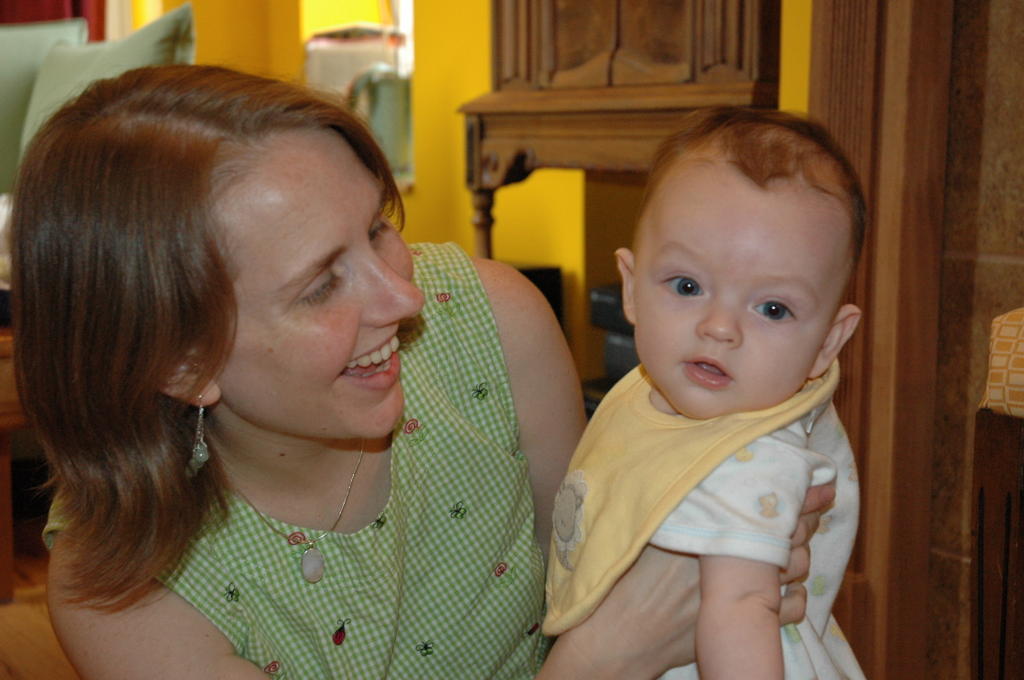
New pictures are up on the site-- enjoy, Okay, seriously, why can't Henry nap at home? We had this last weekend too where during the week he did well at Brenda's and then come Saturday he reverts to our first week of sleep training-- it's so frustrating!
He was exhausted by this evening after taking short 20 minute naps all day and went to bed early. Hopefully tonight goes okay as last Saturday night was the start of Henry crying throughout the night.
We didn't wind up going to the funeral today. JT was feeling worse and Henry had a fever most of the day from his shots so i thought it would be best to stick close to home. He was fairly chipper in between crying bouts and we got some pictures with good ole mom!
Enjoy!
7.26.2005
Sleep Update
I'm sure you're all waiting with baited breath to hear how Henry is doing with his sleep training. I can't say that it's been an easy week and a half, and our progress hasn't exactly been linear, but i do think we are making progress.
Henry has been sleeping 7-8 hours straight at night and then going back to sleep for another 3 or 4 hours. Typically he still cries about 20 minutes before falling asleep both at night and for naps, but every so often he cries much less. He's also been sleeping much closer to 13-14 hours a day which is a definite improvement. Of course usually we feel like we take one step forward and 3 backwards but hopefully as time passes and Henry gets older we'll have less crying before he falls asleep and better naps.
In other news, today was Henry and i's first day at childcare. I've never felt like such a nervous, over-protective new-mom as preparing Brenda for Henry. I think I had her thinking that he was the worst baby ever and when i came to pick him up at noon she said i had nothing to worry about. He cried when i left but settled down and loved watching all the other kids. He cried a bit before he took a nap but did sleep for 30 minutes (we're working on lengthening his naptimes). The biggest news was that he actually took a bottle which he had stopped doing from either JT or I. So tomorrow he'll be there again in the morning and then on Thursday he'll be there all day. I think it was harder on me because i missed him very keenly today. I'm sure in time i'll get used to it but these past three months have allowed me to develop a very strong bond with Henry.
FYI-- there are new pictures on the yahoo site.
Henry has been sleeping 7-8 hours straight at night and then going back to sleep for another 3 or 4 hours. Typically he still cries about 20 minutes before falling asleep both at night and for naps, but every so often he cries much less. He's also been sleeping much closer to 13-14 hours a day which is a definite improvement. Of course usually we feel like we take one step forward and 3 backwards but hopefully as time passes and Henry gets older we'll have less crying before he falls asleep and better naps.
In other news, today was Henry and i's first day at childcare. I've never felt like such a nervous, over-protective new-mom as preparing Brenda for Henry. I think I had her thinking that he was the worst baby ever and when i came to pick him up at noon she said i had nothing to worry about. He cried when i left but settled down and loved watching all the other kids. He cried a bit before he took a nap but did sleep for 30 minutes (we're working on lengthening his naptimes). The biggest news was that he actually took a bottle which he had stopped doing from either JT or I. So tomorrow he'll be there again in the morning and then on Thursday he'll be there all day. I think it was harder on me because i missed him very keenly today. I'm sure in time i'll get used to it but these past three months have allowed me to develop a very strong bond with Henry.
FYI-- there are new pictures on the yahoo site.
7.17.2005
Transitions
Since i last posted Henry and our little family are going through a spate of transitions. There was Henry and i's first trip away from JT when we spent a week at the Delaware shore and DC with family and friends, Henry's continued developmental progress, and preparations for my return to work on the 28th.
Henry will be starting childcare with Brenda the mornings of the 27th and 28th and will then go a full day on the 28th. In order to make the transition less jarring, and to help Henry be a more rested happy baby, we're "sleep training" little Henry.
Sleep is a hot topic with parents-- not only because new parents are so sleep deprived but because how we treat our children's sleep has become a marker of the type of parent we want to be perceived as. There are "attachment parents" who would never dream of letting their children cry themselves to sleep and "cry it out" parents who wouldn't want their children's sleep to be dependent on them for very long.
I feel we're somewhere in the middle but Henry seemed to be suffering from exceptionally poor sleep. He was never a particularly good sleeper but he had gotten to where i couldn't put him down at all during the day and even when holding him he slept very lightly-- continually waking up. I couldn't even nurse him to sleep.
We talked to our pediatrician who hooked us up with a sleep expert here in Chicago. We met with him and developed our plan to put him in his crib before he gets overtired for both his naps and at night. JT goes in after 5, 10 and then 15 minutes and talks to him and tells him things are okay. I asked the sleep expert what the worst he'd heard was in terms of crying-- he said 2 hours.
We were prepared on the first night for Henry to break the record because he's easily cried 2 hours even when we're holding him and soothing him. Luckily he clocked in at 1 hour 40 minutes and then slept for 8 hours-- straight. He had a great night and then cried for only 30 minutes for his first two naps and slept for an hour each time. His third nap however he cried right through (1.5 hours). We got him up and gave him a bath, fed him and put him back down. He only cried about 20 minutes and slept about and hour and then cried another half hour. His night wasn't great after that but it wasn't any worse than before the sleep training. His first nap this morning he only cried about 20 minutes so maybe we'll start seeing some progress.
I believe that Henry is ultimately going to be better off because he's going to be getting better sleep and will be more rested. Yesterday when he wasn't crying in his crib he was calmer and smilier than he's ever been. It's just so hard to get through. I've been sitting on the porch a lot and taking showers. We're hoping that we've made dramatic progress in 4 days or so which is about the norm.
Henry will be starting childcare with Brenda the mornings of the 27th and 28th and will then go a full day on the 28th. In order to make the transition less jarring, and to help Henry be a more rested happy baby, we're "sleep training" little Henry.
Sleep is a hot topic with parents-- not only because new parents are so sleep deprived but because how we treat our children's sleep has become a marker of the type of parent we want to be perceived as. There are "attachment parents" who would never dream of letting their children cry themselves to sleep and "cry it out" parents who wouldn't want their children's sleep to be dependent on them for very long.
I feel we're somewhere in the middle but Henry seemed to be suffering from exceptionally poor sleep. He was never a particularly good sleeper but he had gotten to where i couldn't put him down at all during the day and even when holding him he slept very lightly-- continually waking up. I couldn't even nurse him to sleep.
We talked to our pediatrician who hooked us up with a sleep expert here in Chicago. We met with him and developed our plan to put him in his crib before he gets overtired for both his naps and at night. JT goes in after 5, 10 and then 15 minutes and talks to him and tells him things are okay. I asked the sleep expert what the worst he'd heard was in terms of crying-- he said 2 hours.
We were prepared on the first night for Henry to break the record because he's easily cried 2 hours even when we're holding him and soothing him. Luckily he clocked in at 1 hour 40 minutes and then slept for 8 hours-- straight. He had a great night and then cried for only 30 minutes for his first two naps and slept for an hour each time. His third nap however he cried right through (1.5 hours). We got him up and gave him a bath, fed him and put him back down. He only cried about 20 minutes and slept about and hour and then cried another half hour. His night wasn't great after that but it wasn't any worse than before the sleep training. His first nap this morning he only cried about 20 minutes so maybe we'll start seeing some progress.
I believe that Henry is ultimately going to be better off because he's going to be getting better sleep and will be more rested. Yesterday when he wasn't crying in his crib he was calmer and smilier than he's ever been. It's just so hard to get through. I've been sitting on the porch a lot and taking showers. We're hoping that we've made dramatic progress in 4 days or so which is about the norm.
Subscribe to:
Posts (Atom)